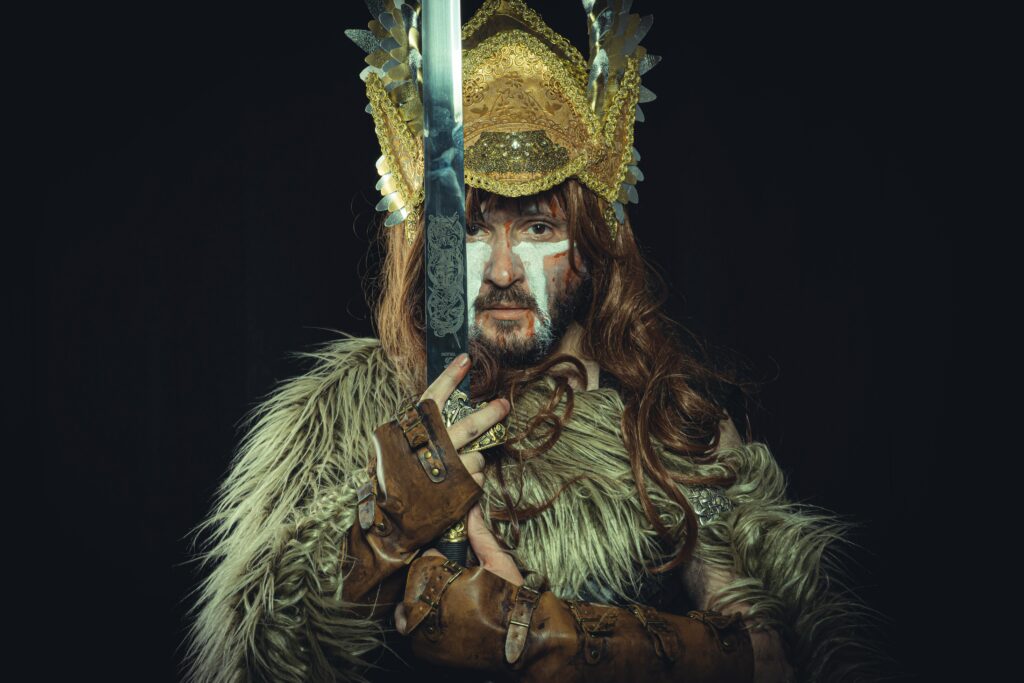
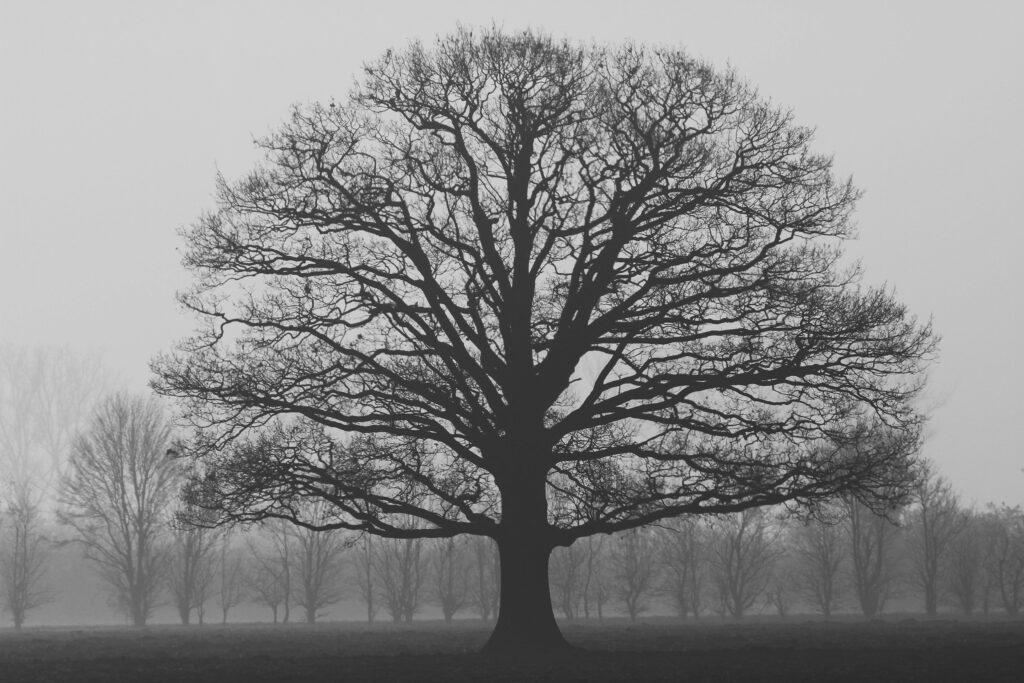
Many people in the Pagan community — especially Wiccans — will be familiar with the myth of the Holly and Oak Kings.
Seen as the personifications of winter and summer, the two are often described as brothers and rivals.
On the solstices, tradition tells us that the two meet in combat, battling for power over the natural world, and the affection of the Wiccan Goddess.
While this myth manages to capture the eternal struggle between the seasons, for many of us, especially those in the queer community, it falls a little bit short.
Heterosexual relationships aside, the myth reinforces the connection between masculinity and violence, and turns the Goddess into an object who has no choice over her partner.
For these reasons, in my lineage of the Feri Tradition, many of us turn this myth on its head, and reinterpret it through a queer lens.
Instead of seeing the Oak and Holly Kings as rivals who battle each other for power, we see them as lovers who give each other their power voluntarily.
This gives a notably different feeling to the myth, as well as our solstice celebrations.
Origins
Where does the myth of the Holly and Oak Kings come from, anyway?
While we often hear that these figures come from Celtic folklore, we don’t have any direct references to back up this claim.
What we do know is that the myth of the Oak and Holly Kings was popularized by Robert Graves in his book, The White Goddess, which had a powerful influence on the modern Pagan movement.
In The White Goddess, Graves gathers and recounts numerous conflicts between different deities and mythological figures, such as Gawain and the Green Knight.
He sees the conflict between the Oak and Holly Kings playing out in these pairs, and as essentially underlying all of them.
Later books, such as The Witches’ God by Janet and Stewart Farrar, link the Oak and Holly Kings with literature and folklore, and describe their place in the Wheel of the Year.
Today, we can find numerous references to the Kings in Pagan literature (see Storm Faerywolf’s, The Satyr’s Kiss, for example).
What’s important to note here, is that like many elements of modern Paganism today — such as Wheel of the Year — the myth of the Oak and Holly Kings is a modern invention.
While we don’t need permission to reinterpret this myth through a queer lens, I think it helps to recognize that the original conception of this pair was itself a reinterpretation of myth and folklore.
What do the Holly and Oak Kings look like?
There are as many ways to see the Holly and Oak Kings as there are people. That’s a lot!
Each of us will visualize them a little bit differently, but the lore does give us some descriptions to go by.
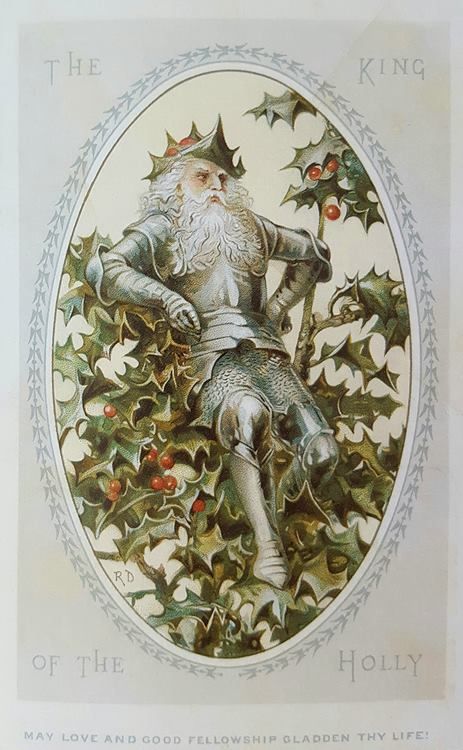
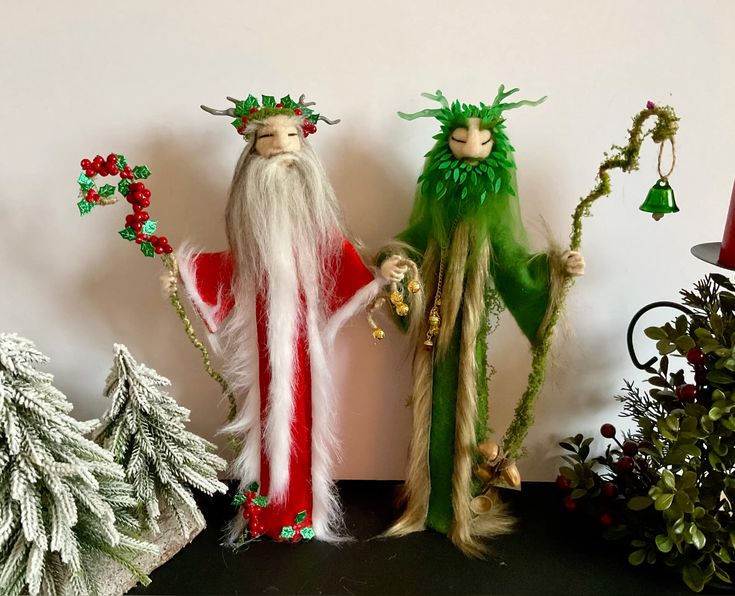
The Holly King, as the ruler of the dark half of the year, is usually seen as the older of the two brothers. Since he traditionally represents maturity, old age, and death, he is frequently depicted as a middle-aged or old man with gray or even white hair.
The Holly King’s traditional color is often given as red — symbolizing both the red berries of the holly tree in winter, as well as the lifeblood of all living things.
Due to his associations with old age, and the color red, he has come to be associated with Santa Claus. His somewhat Saturnine qualities have also led him to be syncretized with Father Time.
The Oak King, on the other hand, as the ruler of the light half of the year, is visualized as the epitome of youth and vigor. As the spirit of new plant life and growth, he is associated with the color green, and often syncretized with the Celtic Green Man.
My visualization of the two is a little bit different.
Since I see the Holly and Oak Kings as a manifestation of the Feri Divine Twins, I visualize them as being around the same age.
The Holly King appears to me with dark black hair, dressed in shades of deep green. The Oak King, alternatively, appears with light brown or even golden hair, dressed in brighter shades of green.
When do they meet?
There has been much discussion about when exactly the Holly and Oak Kings meet, and the answer to this question largely depends on when you believe the light and dark halves of the year begin and end.
The Farrars, as well as my teacher Storm Faerywolf, see the Holly and Oak Kings as meeting and exchanging power on the winter and summer solstices.
The Oak King rules from Midwinter to Midsummer, while the Holly King rules from Midsummer to Midwinter.
The reasoning here is straightforward — the Oak King rules when the days are becoming longer, and the Holly King rules when they are becoming shorter.
Others, however, see the Kings as meeting and exchanging power on the equinoxes. According to this logic, the Oak King would rule when the days are longer than the nights, and the Holly King would rule when the nights are longer than the days.
A third group argues that since the Celts only recognized two seasons — summer and winter — the appropriate times to celebrate the transition of power should fall at Beltane (when Celtic summer begins) and Samhain (when it ends).
A queer winter solstice ritual
If reimagining the Holly and Oak Kings as lovers resonates with you, I would like to present a ritual you can use to honor them.
The ritual does include sexual symbolism, as I feel it’s important to celebrate queer sexuality in sacred space.
Please feel free to add to, or edit, this ritual in a way that is meaningful to you. It can be as simple or ornate as you wish!
Supplies
- A candle for the Holly King. I suggest dark green or red, but you could also use black or silver.
- A candle for the Oak King. I use light green, but you could also use white or gold.
- Two ritual tools to symbolize the union of the Holly and Oak Kings. If you happen to have two wands of holly and oak wood for this purpose — or can make them, ahead of time — that would be ideal. If not, you could use your wand and your athame, your wand and your chalice, or your athame and your chalice.
- Homemade bread, cake, or cookies.
- Spiced wine, grape juice, or unfiltered apple juice.
Prepare your ritual space
Once you’ve assembled everything you’ll need on your altar, give some consideration to how you’ll set the mood for the ritual.
Will you work by soft lamplight, or illuminate your space with candles? Would you like to put on some soft, non-distracting music to set the mood? If you’d like to incorporate scent into your ritual, you might like to choose a cinnamon and anise-scented incense.
Open the way
In the Feri Tradition, opening the way refers to the preparatory work we do before undertaking a ritual. This usually includes grounding, aligning our souls, and performing the Waters of Purity (if you’re not familiar with these practices, you can learn how to do them in my article on spiritual first aid).
Opening the way is a crucial part of every ritual, as it begins the process of calming our mind, and helps us to relax. It gives us an opportunity to cleanse ourselves of anything that might be weighing us down, and enter into an altered state of consciousness.
Create sacred space
From a Feri standpoint, once we have opened the way, lit the Star Goddess candle, and recited the Holy Mother prayer, we are in sacred space.
As I’ve mentioned in my article about the differences between Feri and Wicca, circle casting is an optional practice.
With that said, I do think that circle casting is a nice touch at special times of the year. As Victor Anderson himself affirmed, it creates an ideal environment for connection with the Gods.
Connect with the energy of the solstice
To begin this ritual, we’ll recite a short statement about the significance of the winter solstice. This will help us align with the energy of the holiday, and enter what I call “sacred time.”
Say:
This is the time of the winter solstice, the longest night of the year. Darkness triumphs as the cold settles in, and life retreats deep within the earth.
The sound of horses and hounds floats hauntingly on the air, as the Wild Hunt rides through the sky. This is the season of messages and omens, when we pray for good fortune in the coming year.
On this night of greatest darkness, when the sun stands still, time, for a moment, stops. I touch the eternity at the center of the Wheel; the eternity at the center of my being.
Invoke the Holly King
Take a moment now to envision the Holly King, sitting on the throne of winter. Tonight, he is at the height of his power.
Light his candle, and say:
Lord of the Holly,
Sparkling with frost,
Dripping with crimson berries,
Evergreen King, crowned with spines,
Ruler of velvet darkness.
Feel, or imagine the presence of the Holly King as he enters your ritual space. Greet him, if you wish, and if you there’s anything you want to tell him or ask him, you may do so now.
Invoke the Oak King
Now, visualize the Oak King. He glows with the faint light of the winter sun, and the dream of the summer that is to come.
Light his candle, and say:
Lord of the Oak,
Kissed by lightning,
Studded with orbs of mistletoe,
Ever-changing King, acorn crowned,
Ruler of liquid light.
Feel the Oak King’s presence as he enters your ritual space, and notice how he is pulled to the Holly King.
The Union of Kings
Visualize the Holly King rising from the throne of winter, and opening his arms to the Oak King. Take your ritual tools into your hands, and recite the following:
O shadow-faced King of the regal Holly, regent of the dark half of the year, tonight you meet the King of Oak beneath the star-strewn sky.
In your longing for his brightness, your hand clasps his hand, your mouth seeks out his mouth. Your bodies entwine, enflamed by desire, darkness embracing light.
At this point, if you are using two wands to symbolize the union of the Holly and Oak Kings (or a wand and athame), cross them in the air and then lay them on your altar. If you are using a wand and chalice (or athame and chalice), lower the wand or athame into the chalice. Say:
United in love, the cries of your pleasure are a blessing to all beings upon the earth. You give yourself over, until trembling inside him, you pass on your kingly power.
As the Oak King receives his sacred mandate, the throne of winter becomes the throne of summer. The power of the sun, which has waned until this night, will now begin to grow.
Spend some time in contemplation of the mystery of the Kings’ union.
Celebrate communion
Bless the food and drink that you have brought to this rite, and offer some of it to the Kings. As you eat and drink, do so consciously, mindful of the plants and animals that sustain our life (and how we will one day sustain them).
Close
To close the rite, send a sense of love and thanks to the Holly and Oak Kings. You may wish to express this verbally. Extinguish their candles, if it feels appropriate, or if it’s safe to do so, you may let them burn out.
If you have a cast a circle, proceed to open it, and make sure to extinguish the Star Goddess candle (if you have used one).
Write down your experience, if you are inclined to do so.
Further reading
For a beautiful retelling of the myth of the Holly and Oak King’s love, I recommend reading Sable Aradia’s “The Two Kings: A Tale of Love and the Sharing of Power.”
Story Stag also has a take on this myth: “Oak and Holly.”
Lastly, my teacher, Storm Faerywolf, has written an article on this topic for the Wild Hunt: “Queer Solstice Tidings: Interpreting the Holly and Oak Kings as Lovers Instead of Rivals.”