

The deities we work with in the Feri Tradition, like those of many other pantheons, reflect the different stages of the human life cycle.
If Nimue, our child goddess, is the first reflection in the Star Goddess’s curved, black mirror, then Ana, the wise woman, is perhaps the last.
Much like Nimue, she too, is an androgynous figure — a sign of both her age, and her closeness to the Star Goddess.
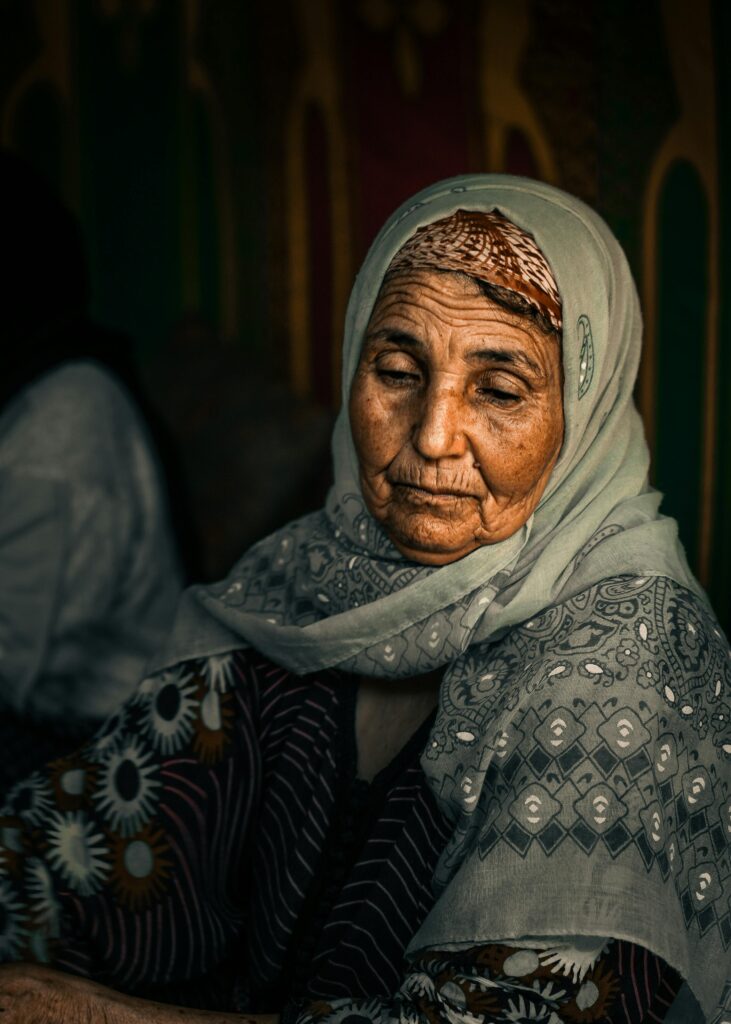
Victor Anderson reportedly said that Ana, along with the Arddu, were “the natural gods of nature.”
What exactly does that mean, and what does it tell us about Ana?
As the archetypal “Hag,” or “Crone,” it’s true that Ana is associated with old age, death, and endings. She is also considered to be the spirit of night, and is often called the Winter Queen, as she rules the hibernal months.
On the other side of every ending, however, is a new beginning. Destruction and death often precede regeneration and new life.
I see Ana as presiding over this intimate connection between death and life, which is always present in nature.
Black Ana: The Dread Goddess of Death
Like many Feri deities, Ana has three aspects — Black, Blue, and White. Each of these Anas has a distinct personality, and rules over different domains.
Black Ana is the archetypal witch, hunchbacked, sporting warts, and dressed in black. Despite this cartoon-like description, I don’t find anything comical about her — she can be a genuinely terrifying being.
To me, Black Ana embodies the repulsive, fear-inspiring nature of the Crone Goddess that often gets glossed over in the Pagan community.
She’s not the smiling, eternally forgiving grandmother many of us have come to associate with the Crone, and it can be hard to sit in her presence.
Black Ana is frequently associated with Baba Yaga and Black Annis, two child-eating figures from folklore that have inspired fear in the hearts of many children.
While I don’t think any of these beings really eats children (and we can argue that this reputation is a demonization of older women and witches), I hold Black Ana in the utmost respect, and do not invoke her lightly.
As the goddess of sorcery, poisonous herbs, and what are often called “the forbidden mysteries,” Black Ana holds powerful wisdom.
While she doesn’t speak in my experience, she does communicate through images and actions. She might show your specific herbs, for example, or even ritual actions that you’re meant to repeat on your own.
That said, your mileage may vary. The gods show up for all of us in different ways!
Blue Ana: Wise Woman and Storyteller
Blue Ana, in my opinion, is the most approachable of the three Anas. She is warmer and gentler than the other two, and has a more inviting, grandmotherly presence.
As Blue Ana’s name implies, she frequently appears dressed in blue. Her clothes always look regal and queenly to me, and I see her as the embodiment of grace and poise.
I personally think Brian’s Froud’s “Faery Godmother” painting is a splendid depiction of Blue Ana (see below).

Blue Ana is known for being a storyteller, and she is sometimes syncretized with Grandmother Spider. In addition to sharing stories with us, I’ve found that she can help us with our own life stories, and learn to see and tell them in new ways.
Blue Ana is also a goddess of wisdom, and I believe that she is invested in helping us to become more wise. In this sense, we can turn to her as a trusted guide, and ask for her help in difficult situations.
White Ana: The Void
White Ana symbolizes the power of the void — a blank piece of paper, or blank canvas. If we are to create something new, we first need a space to do so, and I see White Ana as ruling over this process.
Making room for the new in our lives is rarely easy, and it always comes with a cost. White Ana can help us to understand and accept this most difficult of lessons, and work through our fear of pruning, demolishing, and/or letting go.
White Ana is also known as the Winter Queen — the goddess of the landscape covered in snow. As such, she can also teach us the importance of the fallow times in our lives, of silence, stillness, and rest.

Meeting Blue Ana
If, after reading about Ana, you feel pulled to work with her, I would like to offer this guided meditation that you can use to meet her.
What you’ll need:
- A comfortable place to sit or lie down. Have a blanket handy as your body temperature might drop during the meditation!
- An offering for Ana. Several people I know like to offer her hot tea, while I personally have found she appreciates a glass of whisky. As a goddess who rules over a lot of cold things (i.e. night, winter, the void) I think she enjoys things that warm her up!
- Optional — an earthy incense or oil blend (think vetiver, patchouli, and similar scents).
Start by dimming the lights in your ritual space. Ground yourself and align your souls (if you’re not familiar with those exercises, make sure to read my post on spiritual first aid!).
As you close your eyes, and relax, you see a white mist gathering around you. It rolls in on all sides and supports you, like a soft cushion or pillow. Feel yourself floating on the mist, floating between the worlds.
After a time, you notice that the mist starts to recede, and you find yourself in the middle of a deep wood.
It’s nighttime, in the middle of winter, and you’re walking along a path between the dark shapes of pine trees. Snow and pine needles crunch under your feet as you walk beneath the canopy of branches.
After you have been walking for a while, you notice a glimmer of light to your left, and you peer through the trees to look closer.
You see a wooden cabin a little ways in, with brightly lit windows and smoke coming out of the chimney. You decide to walk towards it, and crunch, step by step, through the snow.
The cabin is built in a little clearing, and the stars are visible overhead. The sound of the winter wind whistles through the trees and an owl hoots in the night.
Slowly, you walk up to the wooden door, and knock on it three times. After a moment, it opens, and you see a figure standing in the doorway before you. It is Blue Ana.
“Welcome,” she says, with a deep smile that reaches her wizened eyes. She invites you to come in out of the cold and sit next to the fireplace.
As you settle into your seat beside the fire, notice what’s around you. There may be tea and cookies on a wooden coffee table — Blue Ana may invite you to help yourself to them.
Sitting by the fire, your eyes meet hers, and she asks, “What brings you to this part of the woods?”
In your own time, you respond. Tell her why you have come to visit her here, even if it’s simply “I felt drawn.”
If there is something in particular that is weighing on you, you might choose to share it with Blue Ana.
Pay attention to what she says or does, and don’t be surprised if she invites you into the kitchen, or another room of the cabin. She might even take you out back into the snow covered garden — just be open to the experience.
Allow yourself ample time to speak with her, and sit in her presence, for however long you need.
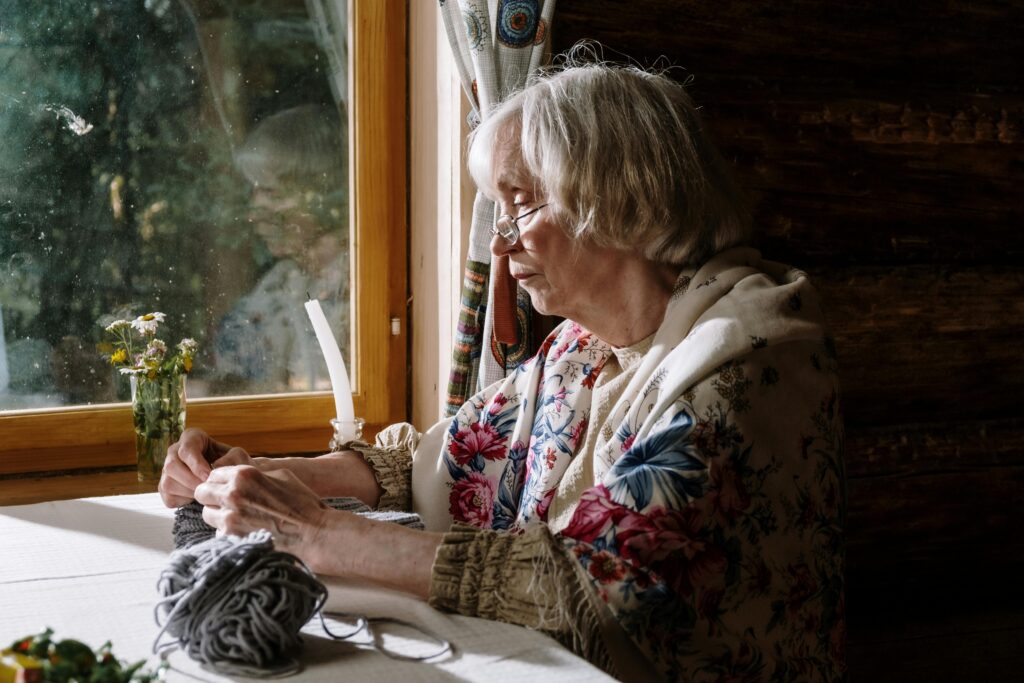
Eventually, when you feel that the interaction is coming to a close, thank Blue Ana for her insights. You may choose to make your offering to her now, or wait until the meditation has ended.
As Blue Ana walks you to the door, you bid each other farewell. She might stay, and watch you walk back through the forest and into the mist, or she might close the door with a smile.
However she chooses to say goodbye, you continue on your way, walking back through the snow, and the pine trees, and back into the mist.
Gently, remember where you are, and open your eyes, bringing your memories of the experience back into the present.